Trade Analysis and Tips for Trading the Japanese Yen
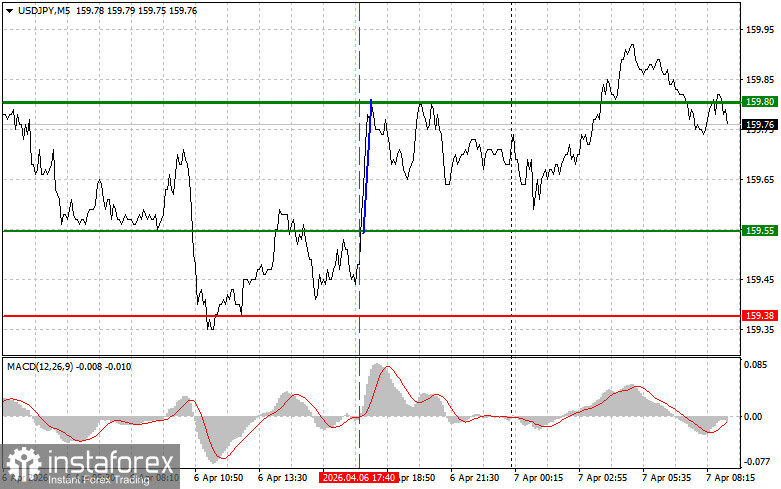
The price test at 159.55 occurred when the MACD indicator was just starting to move up from the zero mark, confirming the correct entry point for buying the dollar. As a result, the pair rose towards the target mark of 159.80.
The yen declined against the dollar on news that Japanese households cut spending for the third consecutive month, even after real wages turned positive, highlighting the unstable state of domestic demand. According to the data, inflation-adjusted household spending in February decreased by 1.8% compared to the same period last year, a faster pace of decline than the 1% drop in January. Economists had expected a 0.8% decline.
The decrease in household spending, especially one as significant, indicates that consumers remain cautious. The reasons for this caution are multifaceted, ranging from concerns about future economic stability to the ongoing impact of inflationary pressure on real incomes. Geopolitical situations around the world should not be overlooked either.
The yen's reaction underscores how sensitive financial markets are to economic signals from Japan, as the data presented paints a picture of unstable domestic demand, which remains a limiting factor for economic growth.
As for the intraday strategy, I will primarily rely on scenarios #1 and #2.
Buying Scenarios
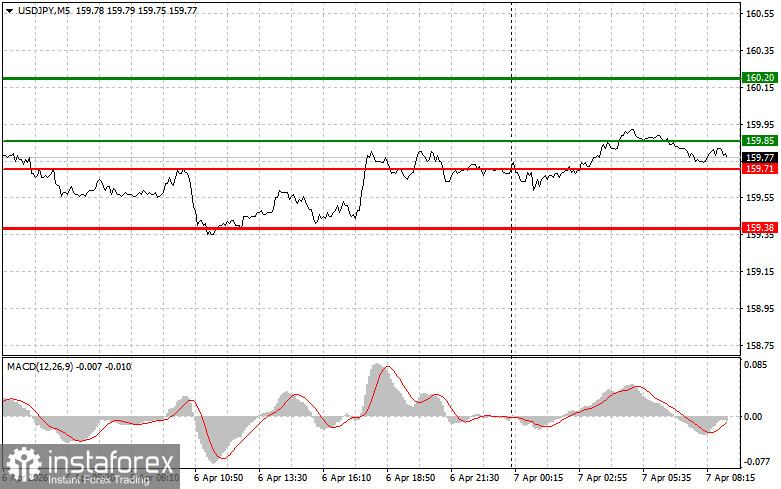
Scenario #1: I plan to buy USD/JPY today at an entry point around 159.85 (green line on the chart), with a target of 160.20 (thicker green line on the chart). Around 160.20, I intend to exit the long positions and open short positions in the opposite direction, anticipating a 30-35-pip move back from the level. It's best to resume buying the pair during corrections and serious USD/JPY pullbacks. Important! Before buying, ensure that the MACD indicator is above the zero mark and just starting to rise from it.
Scenario #2: I also plan to buy USD/JPY today in the event of two consecutive tests of the price 159.71 when the MACD indicator is in the oversold area. This will limit the pair's downward potential and lead to a market reversal upwards. A rise to the resistance levels of 159.85 and 160.20 can be expected.
Selling Scenarios
Scenario #1: I plan to sell USD/JPY today only after breaking the level of 159.71 (red line on the chart), which will lead to a rapid decline in the pair. The key target for sellers will be the 159.38 level, where I intend to exit the shorts and immediately open longs in the opposite direction (anticipating a 20-25-pip reversal from the level). It's better to sell as high as possible. Important! Before selling, ensure that the MACD indicator is below the zero mark and just starting to decline from it.
Scenario #2: I also plan to sell USD/JPY today if the price tests 159.85 twice in a row while the MACD indicator is in the overbought area. This will limit the pair's upward potential and lead to a market reversal downwards. A decline to the support levels at 159.71 and 159.38 is expected.
What Is On The Chart:
- Thin green line – the entry price at which the trading instrument can be bought;
- Thick green line – the expected price where Take Profit can be set, or profits can be secured, as further growth above this level is unlikely;
- Thin red line – the entry price at which the trading instrument can be sold;
- Thick red line – the expected price where Take Profit can be set, or profits can be secured, as further decline below this level is unlikely;
- MACD Indicator. It is important to be guided by overbought and oversold zones upon entering the market.
Important: Beginner traders in the Forex market need to be very cautious when making entry decisions. It is best to be out of the market before important fundamental reports are released to avoid being caught in sharp price fluctuations. If you choose to trade during news releases, always set stop orders to minimize losses. Without setting stop orders, you can quickly lose your entire deposit, especially if you do not use money management and trade large volumes.
And remember, for successful trading, it is essential to have a clear trading plan, like the one presented above. Spontaneous trading decisions based on the current market situation are inherently a losing strategy for intraday traders.